Home / News

Featured News


All Other News
Islamic Lifestyle
SGIE Report 2026: How modest wear is reserving a spot in mainstream fashion

Global Muslim consumer spending on modest fashion reached approximately $347 billion in 2024, reflecting a 6.2% year-on-year increase, and is projected to grow to $444 billion by 2029, at a 5.1% CAGR, according to the State of the Global Islamic Economy 2025/26 Report.  

The continued momentum underscores the steady expansion of modest fashion as a significant segment within the global apparel market, supported by strong demand across key markets including Iran, Türkiye, and Saudi Arabia. 

Beyond its size, the sector is undergoing a structural shift. Modest fashion is transitioning from a niche, identity-driven category into a more integrated segment of the global fashion industry. Growth is increasingly shaped not only by consumer demand, but by how effectively brands and platforms embed modest fashion within mainstream retail environments, digital commerce ecosystems, and broader lifestyle propositions.

This shift is reflected in the increasing presence of modest fashion across established retail spaces, major shopping districts, and international fashion platforms. At the same time, the rise of social and livestream commerce - particularly in Southeast Asia - is reshaping how consumers discover and purchase products, reinforcing the importance of seamless, omnichannel engagement. 

In parallel, early-stage collaborations across sectors such as beauty, travel, and hospitality signal a gradual expansion toward lifestyle positioning, while emerging segments such as men’s modest fashion continue to gain visibility through showcases and brand experimentation.

At the same time, modest fashion consumers are becoming more discerning, with rising expectations around quality, design, and overall brand experience. This evolution is placing greater emphasis on brand positioning, product differentiation, and service delivery, while also encouraging brands to align with broader themes such as sustainability, authenticity, and cultural relevance. 

Investment and capital deployment within the sector are also becoming more strategic, with brands increasingly directing resources toward marketing, brand building, and digital capabilities to support scalable growth.

However, the ability to translate visibility into sustained commercial outcomes remains uneven, particularly where growth is driven by event-based exposure rather than long-term market integration.

Taken together, these developments point to a sector that is expanding in scale while simultaneously evolving in structure. As modest fashion continues to integrate into mainstream fashion systems, future growth will depend on the ability of stakeholders to build commercially sustainable models that extend beyond awareness into consistent demand, brand equity, and global market penetration. 

Collaborations emerged as a key mechanism for accessing new customer segments and embedding modest fashion into adjacent lifestyle categories. 

Experiential retail and hybrid store concepts were increasingly used to deepen engagement and complement digital channels. New product segments and functional innovations broadened the modest fashion market beyond traditional womenswear. Brands increasingly leveraged cultural ambassadors and influencers to strengthen relevance and visibility. International showcases and fashion weeks expanded modest fashion’s presence within mainstream global calendars. 

Several signals of opportunities exist, such as expansion of livestream and social commerce, normalization of modest fashion within mainstream retail and fashion platforms, rising visibility of men’s modest fashion and the broadening of modest fashion into a lifestyle-oriented brand proposition. 
 

Islamic Lifestyle
SGIE Report 2026: Large-scale investments, destination developments, digitalization continue to boost Muslim-friendly travel 

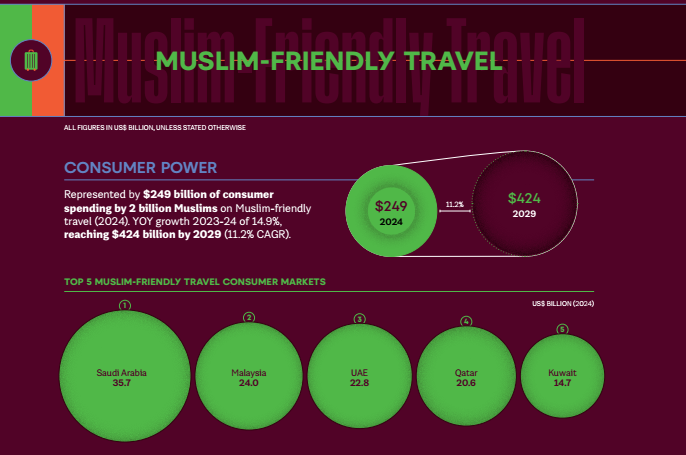
The Muslim-friendly travel sector continues to expand, with Muslim outbound travel spending reaching $249 billion in 2024, up 14.9% from $217 billion in 2023, and projected to reach $424 billion by 2029, reflecting an 11.2% CAGR, according to the State of the Global Islamic Economy 2025/26 report. Saudi Arabia, Malaysia, and the UAE remain the largest Muslim travel markets. 

GCC countries are deepening commitments across Africa and the Arab world, with the UAE and Qatar deploying multi-billion-dollar tourism and real estate pipelines in Egypt and Zanzibar. Gulf capital is re-engaging with Syria through large-scale aviation, real estate, and infrastructure investments, using tourism-enabling assets as early entry points.

Image Courtesy: State of the Global Islamic Economy 2025/26 Report

Saudi Arabia’s Umrah ecosystem is becoming the sector’s most advanced digital infrastructure, with the Nusuk platform now mandatory for visa applications, accommodation, and transport booking, complemented by an integrated digital wallet, an AI-powered air-rail booking system, and a forthcoming credit-profile-based visa issuance model. 

Saudi Arabia opened up investment access in Makkah and Madinah through regulatory reforms and residency incentives, accelerating institutional and high-net-worth capital into Umrah-linked real estate and large-scale accommodation ecosystems.

Artificial intelligence is also being deployed at operational scale across Hajj, covering crowd management, multilingual guidance, and real-time mobility coordination. 

OIC aviation markets are expanding capacity through new airline launches, long-haul low-cost models, and digital-first distribution strategies, backed by significant sovereign and private investment. Saudi Arabia alone plans three new carriers as part of a $100 billion aviation overhaul, while sovereign investment in regional carriers such as AirAsia signals a broader push to expand seat capacity and connectivity.

Mega-events are becoming a programmatic demand driver, with Qatar, Morocco, Uzbekistan, Senegal, and Saudi Arabia hosting or preparing for major international sporting and business events through 2026.

Sustainability is receiving sharper regulatory attention, with airlines facing significant carbon compliance costs and destinations formalizing community-based tourism models to broaden the economic benefits of visitor growth. Cruise operators and travel companies launched and marketed halal-certified, Muslim-friendly, and Umrah-focused cruise offerings across multiple routes, alongside new residential cruise ship plans.

Fintech and innovation initiatives are increasingly focused on pilgrimage finance, transport efficiency, and infrastructure operations across Muslim markets. Middle Eastern destinations are leveraging global entertainment brands and luxury real estate partnerships to anchor mixed-use tourism districts and enhance international appeal. Meanwhile, governments in emerging markets are structuring tourism assets to crowd in private capital.

Looking ahead, the strongest opportunities lie in accessing Saudi destination pipelines, scaling sub-Saharan Africa hospitality exposure through multi-site structures, and embedding Muslim travel tools within existing super-app and airline distribution ecosystems rather than building standalone platform. 

Islamic Lifestyle
OIC countries emerge as top destinations for Muslim women travellers

OIC nations dominate the top 10 destinations for Muslim women travellers due to their established halal-friendly infrastructure and services, a new report has revealed. 

Malaysia, Saudi Arabia and Indonesia remain the top three destinations for Muslim female travellers, with Turkiye and the UAE rounding off the top five countries, the Muslim Women in Travel 2026 report by Mastercard and CrescentRating, revealed. 

Two non-OIC countries - Singapore and South Korea - made it to the top ten list by leveraging targeted marketing campaigns and integrating specialized facilities, the study showed.  

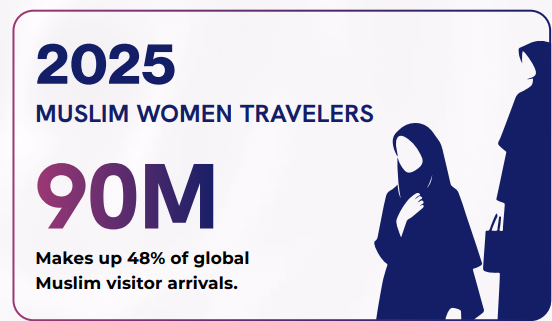
Muslim women travellers grew substantially over the last decade, from 63 million in 2019 to 90 million in 2025, recording a three-percentage-point lift in segment share, and reflecting a significant shift toward independent and meaningful journeys. 

Image Courtesy: Muslim Women in Travel 2026 report 

Muslim women are also primary decision-makers and planners, particularly within the Millennial and Gen Z cohorts. Meanwhile, solo travel has risen from 28% to 35% among Muslim women - led by 18-to-24s. Next-generation tools are also driving the momentum, with nine out of ten Muslim women travelers trusting AI for travel information.

Around 43.6 million MENA-based Muslim women travelled last year, making the region the biggest source market, followed by Central Asia (11 million), Western Europe (7.5 million) and South Asia (6.8 million). 
 

Islamic Lifestyle
Türkiye, Uzbekistan discuss tourism cooperation ties

Turkish and Uzbek officials are exploring ways to strengthen cooperation in tourism, religious and cultural sectors. 

The discussions between officiails underway in Ankara are part of a strategic bilateral partnership, according to UzDaily, a Tashkent-based news portal.

The delegations exchanging notes on Uzbekistan’s activities in the field of charitable endowments and tourism infrastructure development with increased focus on developing the waqf system. 

The sides also discussed the development of pilgrimage tourism, ongoing reforms in the sector, and prospects for expanding cooperation. 

Türkiye and Uzbekistan host a several religious and historical sites revered by Muslims and Christians. Sanctuaries include the Eyüp Sultan Mosque in Istanbul, believed to be the burial place of a companion of the Prophet (peace be upon him), the Blue Mosque, Hagia Sophia and Basilica of St. John.

Uzbekistan is also home to eminent Islamic heritage sites including UNESCO-listed mosques and Sufi shrine across Samarkand, and Tashkent, including the 7th century Osman Quran – a surviving manuscript of the Holy Quran, attributed to the third Caliph, Uthman ibn Affan. 

Türkiye has been courting Central Asian countries to expand cross-border tourism and enhance collaboration with international entities. and Azerbaijan have signed a tourism cooperation protocol to explore ways of boosting tourism and enhancing collaboration within international entities. 

A meeting of the Azerbaijan–Türkiye Joint Tourism Working Group was held in Antalya earlier this month to focus on bilateral tourism cooperation, managing coastal areas for tourism purposes, winter, health, and gastronomy tourism.

Read: How Türkiye is transforming its tourism industry
 

Islamic Lifestyle
GCC tourism could take $32bn hit from Iran conflict  

Tourism revenues losses in the GCC resulting from the US-Israel war against Iran could range between $13 and $22 billion, the GCC secretary-general has said. 

Tourist figures are expected to plunge between 8 and 19 million due to military escalation in the region, state news agency WAM quoted Jasem Albudaiwi as saying. 

Speaking at an extraordinary meeting of the committee of the GCC Ministers of Tourism held on Tuesday, Albudaiwi said that the challenges facing Gulf nations are no longer “a passing circumstance” but rather a true test of the GCC’s ability to ensure continued efficiency and stability of its sectors. 

Data from the Gulf Statistical Centre suggests that GCC countries collectively received more than 72 million tourists in 2025, netting in nearly $120 billion in revenues. 

“The developments we are witnessing today have cast a shadow over the vital tourism sector, impacting travel patterns, the pace of tourism activity and the stability of related markets," he said. 

“[The] escalation necessitates that we all move from traditional coordination to a higher level of practical integration and proactive response, given that the tourism sector in the GCC countries is a fundamental pillar for achieving economic sustainability."

The GCC secretary-general also pointed out that experience has proven that the GCC countries are capable of overcoming all crises and challenges efficiently and effectively, relying on their close ties and effective integration across all fields.

The escalating conflict in Iran is costing the Middle East’s travel and tourism sector a minimum of $600 million per day in international visitor spending, the World Travel & Tourism Council estimated last month. 

Key regional aviation hubs including Dubai, Abu Dhabi, Doha and Bahrain, which collectively process around 526,000 passengers per day, experienced closures and operational disruption amid heightening tension and escalating conflict. 
 

Islamic Lifestyle
Azerbaijan, Türkiye explore boosting tourism cooperation

Türkiye and Azerbaijan have signed a tourism cooperation protocol to explore ways of boosting tourism and enhancing collaboration within international entities. 

The 5th meeting of the Azerbaijan–Türkiye Joint Tourism Working Group, held in Antalya, focused on bilateral tourism cooperation, collaboration within international organizations and tourism education, managing coastal areas for tourism purposes, winter, health, and gastronomy tourism.

Ways of improving the legislative framework for sustainable tourism were also discussed, according to Azerbaijan’s state news agency. 

The discussions emphasized on cooperation mechanisms between the public and private sectors, managing regional tourism and cultural heritage, enhancing experience and information exchange in marketing and promotion, and drafting a joint action program for 2026.

The officials explored cooperation within the UN Tourism, the Economic Cooperation Organization (ECO), the Organization of Islamic Cooperation (OIC), D 8, and the Organization of Turkic States (OTS).

The meeting also addressed cooperation in COP31, the 31st session of the climate change conference to be held in Turkiye later this year. Azerbaijan hosted COP29 in November 2024. 

It was noted that, for the first time in COP history, tourism was included in the thematic agenda, and an agreement was reached to share Azerbaijan’s experience in this area with Türkiye.
 

Islamic Lifestyle
British Muslims give £2.2bn annually: Equi report

British Muslim charitable giving is playing an increasingly important economic and social role in supporting frontline public services across the UK, according to a new report by policy and research organization Equi.

The report estimates that Muslim donors contribute approximately £2.2 billion annually, making them one of the most active charitable communities in the UK.

The study, "Building Britain: British Muslims Giving Back", finds that Muslim-led charities are increasingly directing funds toward domestic priorities, including housing support, mental health services, youth programs, and emergency financial assistance, as public sector budgets face sustained pressure. 

Authored by Taibah Al-Fagih and Dr Mohammed Sinan Siyech, the Equi study combines polling data, interviews with charity sector leaders, and broader industry analysis.

It estimates that British Muslims contributed around £2.2 billion in charitable donations during 2023–24, with roughly half of respondents indicating plans to increase their giving in the year ahead.

The report also finds that higher-income Muslim donors, particularly those earning between £75,000 and £99,000, give at significantly higher rates, contributing up to ten times more than similarly paid individuals in the wider population.

The report also argues that faith-based giving is evolving into a structured ecosystem that complements state services rather than operating solely as a humanitarian charity, with Muslim giving levels being significantly higher than national averages, reaching up to four times the general population’s donation rates and rising further among higher earners.

Shift toward domestic priorities
Historically, a significant share of British Muslim charitable giving has been directed toward international humanitarian causes, shaped by transnational family connections and a strong sense of global solidarity. However, the Equi report identifies a noticeable shift toward domestic priorities, particularly among younger donors.

Third- and fourth-generation British Muslims are increasingly focusing on local challenges such as homelessness, food insecurity and child poverty, reflecting growing awareness of social pressures within UK communities. The study notes that younger professionals, in particular, are responding to visible inequalities and crises closer to home.

Polling conducted by Savanta on behalf of Equi indicates that British Muslims give around 10% more than the national average to mental health and healthcare charities. At the same time, contributions to international humanitarian causes remain significantly higher than national benchmarks, a trend the report partly attributes to greater familiarity with overseas charitable needs compared with domestic social issues.

The research highlights several organizations contributing to local impact. The National Zakat Foundation, established in 2011 to address poverty within the UK, has distributed more than £25 million to over 21,000 beneficiaries, providing housing assistance, emergency grants and employment support.

In 2023 alone, the charity allocated £7 million in zakat funds, with 76% directed toward hardship relief. Its housing program helped prevent evictions that year, generating estimated public sector savings of £28.8 million — equivalent to £73 saved for every £1 donated.

Other examples include Islamic Relief UK, which provided £5 million in grants to domestic initiatives in 2024, and Al-Khair Foundation, which contributed £300,000 to Great Ormond Street Hospital while also supporting emergency responses during events such as the Rochdale floods and the Grenfell Tower tragedy.

Equi also estimates that Muslim-led youth programs contribute up to £30 million annually in avoided public costs by supporting young people at risk and reducing pressure on local services.

The report frames this trend as a structural transition in the UK’s Islamic social finance landscape, reflecting growing awareness of local socioeconomic needs alongside global obligations such as zakat and sadaqah.

Mosques as an underutilized social infrastructure
Equi highlights the potential role of more than 1,000 mosques across the UK as community hubs capable of scaling support services. With improved funding frameworks and greater policy engagement, these institutions could expand their contributions to areas such as public health outreach, youth development, and welfare support.

Barriers and policy recommendations
The report states that despite their growing impact, Muslim charities continue to face structural challenges, including de-banking risks, restrictive funding conditions, and limited institutional recognition.

Equi recommends greater collaboration between policymakers and faith-based organizations, including the introduction of match-funding mechanisms and improved faith literacy within public institutions.

The report concludes that recognizing both the moral imperative and fiscal value of Muslim philanthropy could unlock billions of pounds in additional social investment while strengthening community resilience and public service delivery.

Islamic Lifestyle
London Muslim shopping festival draws thousands to ExCeL London


The London Muslim shopping festival 2026 concluded at ExCeL London on February 7–8, bringing together more than 350 exhibitors and tens of thousands of visitors for a two-day pre-Ramadan lifestyle event focused on retail, food, travel and community engagement.

Organised as a platform for Ramadan and Eid preparation, the festival featured a large retail bazaar showcasing modest fashion, halal food products, fragrances, home décor and Islamic gifts, alongside dedicated zones for travel, sports activities and live cooking demonstrations.

The event also hosted celebrity chef and author Nadiya Hussain, who held a book signing and meet-and-greet session for her latest cookbook "Rooza." Live cooking demonstrations formed a central part of the programme, with chefs presenting Ramadan-inspired recipes and interactive sessions for visitors.

More than 30,000 attendees were expected across the weekend, according to organisers, positioning the festival as one of Europe’s largest Muslim-focused retail and lifestyle gatherings timed ahead of the holy month. Alongside shopping, the event included the 'Muslim Travel Show', which promoted halal-friendly destinations, Umrah packages and travel deals, supported by tourism partners such as Visit Sarajevo.

A large halal food court offered international cuisines from street-food vendors and artisan producers, reflecting growing demand for diverse halal dining experiences. Other interactive features included the 'Active Sunnah Sports Zone', where visitors participated in activities such as archery, football and golf, and the 'Kids Zone', which hosted educational workshops, arts and crafts sessions and family-focused entertainment.

The festival also incorporated practical facilities including dedicated prayer spaces, family areas and health-focused initiatives, including free health checks, highlighting the organisers’ aim of combining retail with community wellbeing.

Exhibitors represented a broad range of sectors, including modest fashion brands, halal finance services, educational resources and lifestyle products aimed at Ramadan preparation. Industry participants used the event as a platform to engage directly with consumers ahead of a peak seasonal shopping period.

Now in its ninth year, the London Muslim Shopping Festival has expanded its focus beyond retail to include travel, wellness and experiential programming, reflecting broader trends within the Muslim lifestyle economy.

Islamic Lifestyle
Malaysia and Saudi Arabia joint luxury Umrah cruise launch faces delays

Malaysia's IslamiCruise, which was being launched as Asia’s first luxury Umrah cruise programme, in partnership with Saudi Arabia’s Aroya Cruises, is facing scheduling problems. The inaugural January–February 2026 voyage has been rescheduled as organisers revise routes and packages.

The 15-day, fully halal-certified cruise was officially introduced as part of Malaysia’s halal tourism push and recognised as a Visit Malaysia 2026 product. Departing from Port Klang, the one-way journey is designed to take pilgrims to Jeddah via Banda Aceh, Oman and the Maldives, before passengers complete their Umrah pilgrimage in Saudi Arabia.

IslamiCruise International announced on November 19, 2025, that sales had been temporarily suspended due to internal assessments indicating a need to better align sailing schedules with market demand and school holiday periods. The company said it remains in discussions with Aroya Cruises’ owners to finalise a revised and commercially viable launch date.

The cruise vessel can accommodate more than 3,500 passengers and offers four accommodation categories, ranging from standard cabins to suites and villas. Onboard facilities include swimming pools, water slides, sports amenities and halal dining, alongside religious programming and lectures led by Malaysian preacher Ustaz Wadi Anuar and Indonesian scholar Ustaz Abdul Somad.

While the programme is designed primarily for Muslim travellers performing Umrah, non-Muslim passengers are also permitted to join the cruise, with tailored packages that exclude pilgrimage activities.

Organisers estimate the initiative could attract between 6,000 and 8,000 visitors annually once fully operational, supporting Malaysia’s broader ambitions to strengthen its position in the global halal and Islamic tourism market.


Most Viewed

Events & Courses

Special Coverage

Top 30 Business Schools of the Islamic Economy 2026

View all

30 Notable Islamic Fintechs - 2026

View all

30 Notable Islamic Fintechs - 2025

View all

Global Islamic Fintech Report 2025/26

View all

15 Most Active VCs in the Islamic Digital Economy

View all

State of the Global Islamic Economy (SGIE) 2024/25 Report

View all

Global Islamic Fintech Report 2024/25

View all

Top 30 Digital Islamic Economy Startups 2024

View all

Top 30 OIC Halal Products Companies 2023

View all

Gaza Crisis

View all

Global Islamic Fintech Report 2023/24

View all

The State of the Global Islamic Economy 2023/24 Report

View all

Global Islamic Fintech Report 2022

View all

State of the Global Islamic Economy 2022

View all

Food Security

View all

Women in the Islamic Economy

View all

COVID-19 and the Global Islamic Economy

View all

E-book: Impacts of the COVID-19 outbreak on Islamic finance in OIC countries

View all

State of the Global Islamic Economy 2020/21

View all

Global Islamic Fintech Report 2021

View all