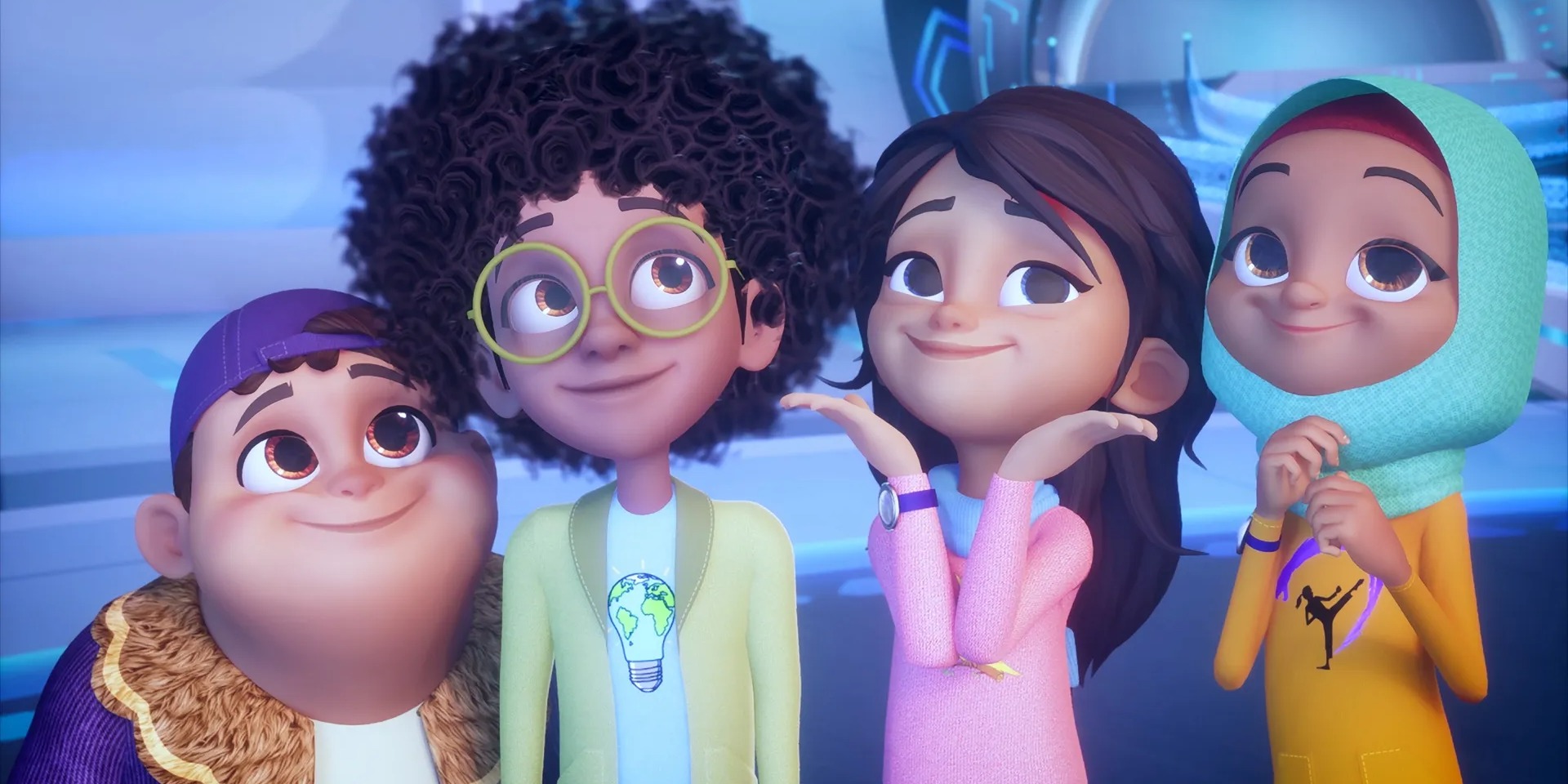
How the 'Time Hoppers' movie is bringing Islamic history to life
The debut of Canadian-produced animated film Time Hoppers: The Silk Road in Saudi cities of Riyadh and Jeddah late last year reflected a growing global appetite for Muslim-centered storytelling.
Developed by Milo Productions Inc., an Alberta-based production house and the media company behind MuslimKids.TV, the film celebrates the Golden Age of Islam and spotlights figures such as Al-Khwarizmi, Ibn al-Haytham, Maryam al-Astrolabi, and Mansa Musa.
Curated in collaboration with US distributor Fathom Entertainment, Time Hoppers is part of a broader multimedia franchise that includes a game, a TV series, and a planned sequel.
It was released in over 200 theaters across the MENA region, and is set to hit more than than 500 screens in the US, the UK, and Canada - becoming the first Muslim animated film to receive a nationwide US release.
We spoke with Michael Milo and Flordeliza Dayrit, the husband-and-wife duo and co-founders of Milo Productions, about their experience in bringing this project to life and what comes next.
What do you think has been key to Time Hoppers reaching this level of success?
Milo: On the commercial side, I think we're being considered a bit of a test case. The theatre industry understands that there is a very large, untapped audience of Muslim viewers out there, and they may look to the success of the Korean or Latin American animation industry and consider that Muslims are a quarter of the world’s population. Turkish cinema has done very well internationally. So why don't we see what's available and whether we can open new markets or revenue streams and get this audience into the theatres more.
I think that could be part of the reason. Of course, the quality of the movie is there, and the story is there. All of that is also very strong.
How has the response been so far? What are people saying?
Dayrit: We were at the American International University. We had lunch with the administration executives after the viewing, and they were thanking me for representing the Muslim culture and history so well in the movie. They said, “This is what we've been waiting for”.
Another interesting moment and what so far was the biggest reward for me was seeing a little boy come up to us; he didn't know who we were, but he was so excited and talked about the movie.
Michael asked him who his favourite character was in the movie. He showed us a poster he had of Time Hoppers and said, “All of them. I love all of them.” And then he started naming each character. For me, the reward of all of this is when you see children as young as four and five, able to relate to the superheroes of the movie.
That’s exciting, and it must feel incredibly rewarding. So, what’s next on your agenda?
Dayrit: We really wanted to showcase the contributions of Muslims and Arab scholars throughout time; that’s something we want to continue doing.
In North America, the representation of Muslim and Arab children is very low. A study from few years ago revealed that just 1% of Muslim Arabs and Southeast Asians were represented in children's media, and for Arabs it was only one character, and that too a supporting one.
In Alberta where we are based, the pioneers of that Canadian province are actually Muslim Arabs. They were entrepreneurs and were competing with Hudson's Bay Company as traders at that time. For them not to be represented in local media is unusual. In Edmonton, the capital of Alberta, the number of Muslims is quite large. And it’s a similar situation across Canada, the United States, and Australia.
What we're doing with Time Hoppers is a franchise. We have the game, the movie, and we're going to be releasing a TV series, which is almost complete. We also have a plan for a sequel. We would definitely like to see investors and people in the field join us on this journey – we welcome the opportunity to produce it with us.
What challenges did you encounter while producing Time Hoppers, especially considering that you were aiming for an international audience?
Milo: One of the challenges is that you're doing children's content. For example, in Turkey and Southeast Asia, especially Malaysia, the industry is very well developed. But in the MENA region, kids’ content isn't as well developed, so it takes a lot of convincing for distributors to bet on the content and know it will resonate with audiences.
Another challenge is that much of the children's industry is built around big-name brands, such as Barbie and Disney. These brands have the pockets to develop a massive franchise, whereas an independent like a David and Goliath type of story may be high risk, but also high reward if it does take off.
So, from our perspective, you're battling against that perception in the market that this isn't necessarily going to [take off], and that it's a lot more difficult to earn money off of an independent product or a newly released product. It's harder convincing people to get behind it. But then there are those people who believe that this is higher risk, but also higher reward.
When it comes to the subject matter, one approach in the animation industry is to make it as generic as possible because that's going to be able to sell a lot wider.
For us, we look at the successes of the Korean animation industry, they're unapologetic about their culture, and the Turkish successes as well. They don't try to make their culture generic; they represent who they are. We wanted to do that in the kids’ space.
Kids are open minded. They don't mind seeing things that are different and learning from them, and they like to see a reflection of themselves in the content they are watching.
There’s clearly an appetite for something different. And the fact that you're creating a franchise around Time Hoppers is impressive. Is the game available already?
Dayrit: Yes, it's available via iOS, Android and Steam. We want children to get to know more about the characters, the superheroes, and to be one of them, but also get to learn about Muslim and Arab scholars and scientists.
The sky's the limit really when you consider what you can build with an Islamic values-driven media franchise, right?
Milo: Yes. There are over two billion Muslims around the world, yet it's an untapped market. If we want to capitalize on that potential, it does require investment to make an impact. That’s one of our aspirations.
Salaam Gateway