How Zakat is bridging the Middle East’s $1 billion-a-day crisis
As Ramadan 2026 draws to a close, the Middle East is confronting a stark reality. While the region’s ongoing conflicts are estimated to cost a staggering $1 billion a day, humanitarian organizations are grappling with shrinking budgets and record-breaking displacement.
According to the International Organization for Migration (IOM), more than 19 million people are currently internally displaced across the Middle East.
Amid these overlapping and incessant crises, Zakat has transformed from a religious obligation into a sophisticated, multi-million-dollar engine of survival.
“Zakat provides a structured system of support that can quickly reach those most affected,” Annabel Turner, communications officer at IOM tells Salaam Gateway.
“Across the region, these funds are helping sustain refugees, widows, and families struggling to survive.”
Faith-based giving meets humanitarian response
This Ramadan, humanitarian organizations are expanding efforts to channel Zakat into emergency relief programs across multiple conflict zones.
IOM recently launched the second edition of its annual Share the Blessings campaign through its Islamic Philanthropy Fund (IPF).
The initiative builds on last year’s pilot project focused on Sudan, expanding its reach this year across multiple humanitarian emergencies, including Afghanistan, Bangladesh, Gaza Strip, Sudan, Syria, and Yemen.
“This year’s campaign combines faith-aligned giving, broader reach, and a transparent digital platform to make Zakat a tool for immediate relief and longer-term resilience,” says Turner.
Since launching in 2025, the IPF has secured more than $20 million in pledges and commitments, which will enable it to support over 30,000 people affected by humanitarian crises, according to Turner.
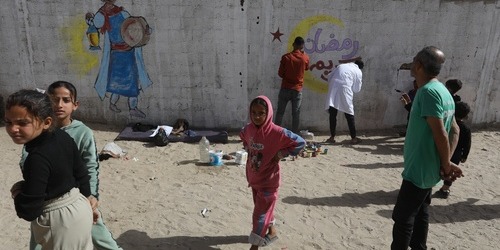
For Islamic Relief Canada, a major focus of this year’s Zakat program is emergency support for Gaza, where funds will help provide food assistance, clean water, medical services, and cash support to families affected by the ongoing crisis.
“The program aims to support over 600,000 people, including children, elderly individuals, and people with disabilities,” Houda Kerkadi, media and press relations specialist at Islamic Relief Canada tells Salaam Gateway.
In 2025, Islamic Relief Canada raised 33.87 million Canadian dollars in Zakat funds, an increase from 31.25 million Canadian dollars in 2024 and 22.06 million Canadian dollars in 2023, reflecting continued growth in Zakat giving. Combined with other charitable contributions such as Sadaqah, the funds enabled the NGO to support more than 4.4 million people worldwide in 2025.
At the same time, local organizations are scaling up their own Zakat initiatives. Amman-based NGO Tkiyet Um Ali directed its 2026 Ramadan Zakat funds to vulnerable families in both Jordan and Gaza, where it delivered food parcels and rehabilitated shelter facilities for 6,000 displaced people.
Elsewhere, Egypt’s Tahya Misr Fund recently partnered with the House of Zakat to send 780 tonnes of food and essential supplies to the Gaza Strip, providing crucial support to displaced families during the holy month.
Rebuilding healthcare infrastructure
While many organizations focus on immediate relief, the Syrian American Medical Society (SAMS) is using Zakat to solve a different crisis: the collapse of healthcare. After more than a decade of conflict, Syria’s healthcare system remains severely damaged, with many hospitals destroyed or left without the resources needed to function.
Dr. Abdulfatah Elshaar, SAMS Foundation chairman, says the financial burden of healthcare often pushes already vulnerable families into complete financial collapse.
"Access to free healthcare removes one of the largest financial burdens vulnerable families face," Dr. Elshaar tells Salaam Gateway. "It means parents do not have to choose between paying for treatment and providing food or shelter for their children."
To sustain these lifelines, SAMS is investing heavily in rebuilding healthcare infrastructure, including $12 million for the Idlib Specialty Hospital and $6 billion for the Idlib Maternity & Children’s Hospital.
“This Ramadan, our focus is sustaining life-saving medical services while continuing to rebuild healthcare systems for communities that have endured years of conflict and displacement,” says Dr. Elshaar.

Today, SAMS supports more than 65 healthcare facilities across Syria, offering services ranging from maternity care and cancer treatment to mental health support. In 2025 alone, the organization delivered more than three million medical services to over one million patients.
The impact of these services is reflected in individual stories like that of Fatima, a displaced mother from rural Aleppo who recently delivered her baby safely at a SAMS-supported maternity hospital after months without access to medical care.
"Stories like Fatima’s reflect the vital role these facilities play in protecting the lives of mothers and children," says Dr. Elshaar.
The widening gap between need and funding
Despite the growing scale of Zakat-funded initiatives, the humanitarian needs across the region continue to outpace available resources.
Across the region, wars, economic collapse, and climate shocks are pushing new populations into poverty each year. In places like Gaza and Sudan, repeated displacement has stripped many families of their homes and livelihoods.
“The biggest challenge is the scale of need,” Karim Amer, UNRWA's director of partnerships tells Salaam Gateway. “The gap between what Zakat can do and the level of funding needed to meet the growing humanitarian needs remains enormous.”
Long-term recovery poses another hurdle.
“Critical gaps remain in underfunded and protracted crises, as well as longer-term recovery and livelihoods support,” says Turner.
While Zakat is highly effective in delivering immediate relief, rebuilding entire communities requires sustained investment over many years.
Organizations like SAMS are increasingly pairing emergency support with longer-term development initiatives. Through its Syria Health 2030 campaign, the group is investing in major projects designed to restore the country’s healthcare capacity.
Similarly, Islamic Relief Canada is expanding programs that combine emergency aid with longer-term recovery.
“While much Zakat funding understandably supports immediate humanitarian needs, expanding its use in areas such as livelihoods, education, and economic empowerment can help create more sustainable pathways out of poverty,” explains Kerkadi.
“Strengthening the connection between short-term assistance and longer-term resilience could help maximize the overall impact of Zakat.”
Zakat contributions are doing far more than fulfilling a religious obligation across conflict zones - this steady stream of funding is keep hospitals accessible, preventing families from being evicted, and delivering a fragile sense of stability to a people who perhaps have very little left to lose.