Middle East growth hardest hit from Iran war, IMF says
Growth across the Middle East and North Africa region has bore the biggest brunt of the Iran conflict, significantly eroding regional output and progress.
The MENA region’s growth is expected to slow down to 1.1% in 2026, from 3.2% last year, before recovering to 4.8% in 2027, as the region faces the most direct impact of the current war, the International Monetary Fund (IMF) has estimated. The region's 2026 growth forecast has been lowered by 2.8 percentage points from the fund's January projections.
For commodity exporters directly affected by the conflict, diminished production and exports imply a severe downward revision of GDP growth projections for 2026, the fund said in its latest World Economic Output (WEO) update released this week.
“The contraction of GDP growth for 2026 is therefore more pronounced for Bahrain, Iran, Iraq, Kuwait, and Qatar and less significant for Oman, Saudi Arabia, and the United Arab Emirates," the IMF said in its report.
"For all these economies, growth in 2027 is expected to rebound, based on the assumption that energy production and transportation are normalized over the next few months - an assumption that may need to be revised if the duration of the conflict extends and the degree of damage suffered gets reassessed.”
The fund lowered estimates for Saudi Arabia’s GDP forecast for 2026 by 1.4 percentage point relative to January, to 3.1%, while revising it upward by 0.9 percentage point, to 4.5% for 2027.
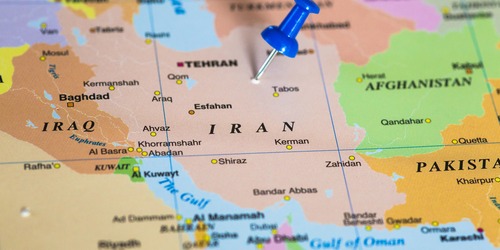
Iran is among the worst hit countries in terms of downward growth revision, with its economy revised downward by 7.2 percentage points compared to IMF's January estimate, to -6.1% before rising sharply to 3.2% in 2027.
In Egypt, growth is projected to slow to 4.2% in 2026 and recover to 4.8% in 2027, a cumulative downward revision of 1.1 percentage points.
"For commodity importers in the MENA, the terms-of-trade shock from higher commodity prices contributes to a somewhat modest downward revision of growth projections in 2026 and 2027, with some differentiation as a result of varying exposures to imports of energy, energy derivatives, and food items, as well as different economic trajectories before the conflict erupted," the report read.
The fund has estimated global and regional growth under several operating scenarios. Under the assumption that the conflict will be relatively short-lived, global growth is expected to slow down to 3.1% in 2026 and 3.2% in 2027, down from 3.4% achieved last year.
In case of a more protracted conflict, in which production and transport activities may take longer to resume than anticipated, the fund has taken two downside scenarios in consideration.
In the adverse scenario - where oil prices would spike 80% and gas prices for Europe and Asia would rise 160% by the second quarter relative to the fund’s January baseline, as well as one-year-ahead inflation would soar by 50 basis points across advanced economies and 90 basis points in emerging markets by 2027 – global growth is estimated to drop to 2.5% in 2026 before rising to 3% next year.
Global growth is estimated at 2% in 2026 and 2.2% in 2027 under a severe scenario in which oil prices would double while gas prices would rise 200% starting in the second quarter of 2026 relatively to the January WEO update baseline. Such a scenario would see one-year-ahead inflation spiking 100 basis points in advanced economies and 130 basis points in emerging markets by 2027.
“The current hostilities in the Middle East pose immediate policy trade-offs: between fighting inflation and preserving growth and between supporting those affected by the rising cost of living and rebuilding fiscal buffers. Amid frequent global shocks, countries need to calibrate policies to ensure that they not only step up to the moment but also stand up to the next test,” the fund added.