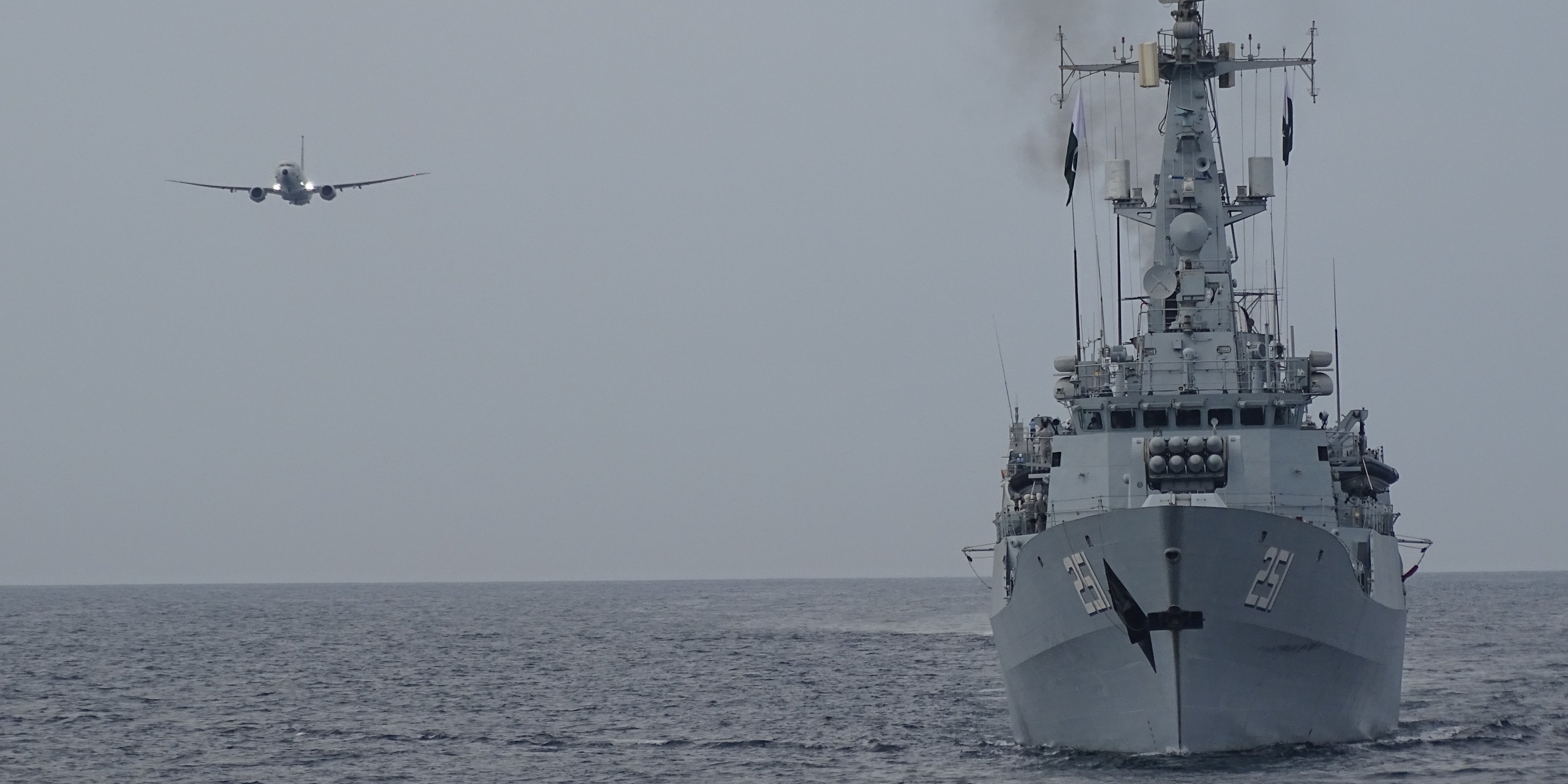
Image Courtesy: U.S. Naval Forces Central Command/U.S. 5th Fleet X account (formerly Twitter)

OIC Economies

Rethinking Gulf security through regional resilience


In May 2025, during a historic visit to the Middle East, US President Donald Trump commended regional leaders in an unprecedented manner, stating, “The birth of a modern Middle East has been brought by the people of the region themselves, the people that are right here, the people that have lived here all their lives, developing your own sovereign countries, pursuing your own unique visions and charting your own destinies in your own way.”  

Despite this growth, which President Trump called an indigenous success, a persistent challenge remains. 

Gulf states like Saudi Arabia, the UAE, Kuwait, and Qatar heavily rely on external security guarantees. However, these guarantees have not prevented adversaries from attacking, which was their primary strategic goal.

On the contrary, US military presence has resulted in making Gulf countries more vulnerable to Iranian attacks, resulting in asymmetrical warfare where Iran is able to impose disproportionate strategic and economic impact. 

This overdependence raises a pertinent question about long-term reliance, the need for further coordination, and regional sustainability. Moreover, the recent downing of a US fighter jet, F15E, by Iran on Friday, April 3, marks a significant shift in West Asia’s security calculus. This anomaly not only exposes the fragility of US deterrence expanded through the Gulf states but also intensifies the urgency for them to revisit their defence architecture.

Across the Gulf states, core security functions such as air defence, coordination, and intelligence are either directly shared with the US or enabled through US installations. The presence of thousands of US troops in the region, along with the Central Command Forward Headquarters at Al Udeid Air Base in Qatar, and the US Navy’s Fifth Fleet in Bahrain, has enabled the region's deterrence posture, in which Gulf security remains deeply embedded in American guarantees.

Two problems emerge with this forward-deployed US architecture: first, the defence system is overly reliant on US-supplied systems, such as the Patriot PAC-3 and THAAD air defence batteries, which have thwarted multiple range missiles but failed to mitigate the greater economic and strategic impact. 

Secondly, the effectiveness of the existing architecture - which is less dependent on national capabilities and regional integrated networks, but more on American command, control, and surveillance systems - limit the effective eradication of total harm. 

However, the unpredictability of these security dynamics calls for Organization of Islamic Cooperation (OIC) countries to reassess the security landscape. 

Unlike European countries, Gulf countries lack a formal institutional framework that limits the full spectrum of regional integration. In the short term, Gulf states can adopt a distributed defence model that includes joint development and production of defence hardware, such as drones and missile systems, for immediate action. 

Moreover, these states can leverage Turkiye's already established military capabilities for drone production and create a balance by extending their dependence beyond the US towards Pakistani and Chinese defence systems. More critically, there is a need for cooperation in software and systems integration, including shared command-and-control (C4ISR) and early warning systems. 

The existing gap in shared detection and interception calls for a unified operational layer that enables coordinated responses rather than parallel, ineffective national actions. Moreover, growing supply chain disruptions calls for joint stockpiling, which can mitigate the risk of supply constraints and, in turn, reduce long-term dependence on external suppliers.

The Gulf’s current security dilemma is not due to a deficiency in capability but rather a lack of autonomy integration. The ongoing dependence on the United States has provided immediate protection but has also created lasting weaknesses, leaving regional countries exposed to threats they were originally intended to be protected from.

As recent developments illustrate, advanced systems without coordination and deterrence without sustainability cannot provide enduring security.

Recalibrating this model is now essential. Gulf states need to shift from relying on external support to building regional resilience, which involves strengthening local capabilities, forming diverse partnerships, and establishing collective defence strategies within platforms like the OIC. Without this change, the region could remain caught in a cycle in which security is outsourced.

Muhammad Rizwan is a research scholar at Deakin University, Melbourne, and Fatima Saif Khan is a research associate at the Centre for Governance Research, Lahore.


Author Profile Image
Muhammad Rizwan & Fatima Saif Khan