Image Courtesy: Arab News

The Philippines is building the architecture for a halal economy


Even though it is a predominantly Catholic country of approximately 113 million, of which Muslim households made up around 6.4%, the Philippine government has intensified its policy and institutional support for the global halal market since 2024.

Two major initiatives represent a shift from ambition to organized execution: the Philippine Halal Industry Development Strategic Plan 2024–2028 and the National Halal Industry and Development Office (NHIDO).

The policy framework
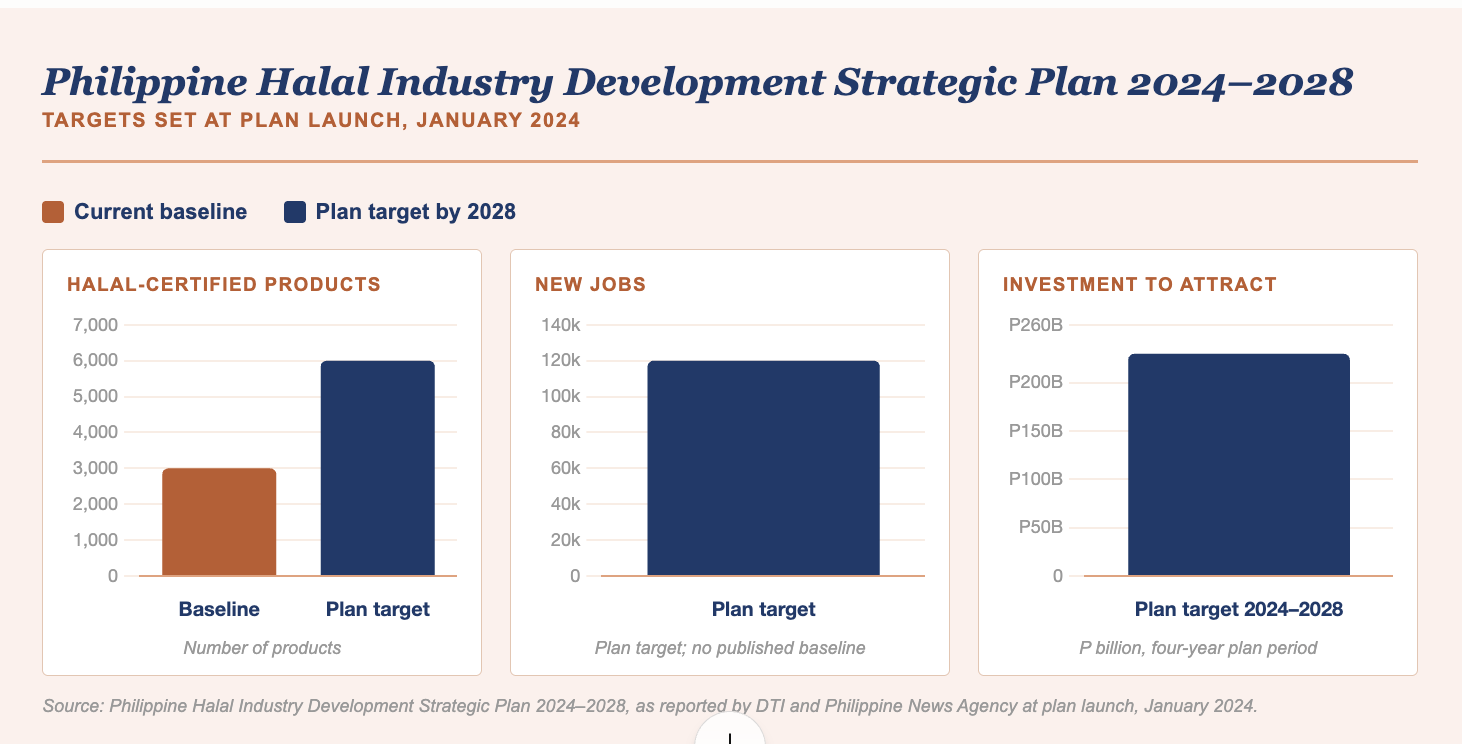
The strategic plan, unveiled in 2024, sets targets to double the number of halal-certified products and services from around 3,000 to 6,000, create 120,000 jobs, and attract P230 billion (roughly $4 billion) in investment across the four-year plan period to 2028. 
 

To ensure that halal development is treated as a cross-cutting economic project rather than a single ministry's brief, a nine-agency task force oversees it, with NHIDO serving as the implementation body.

The office serves as the central coordinating body for all halal development work across the country, simplifying certification for micro, small, and medium enterprises, building halal trade hubs across Luzon, Visayas, and Mindanao, partnering with local government units on halal-compliant infrastructure, and managing a comprehensive halal industry database. Certification bottlenecks have historically been one of the biggest barriers for small Filipino producers entering the halal market. NHIDO's explicit mandate to tackle this is one of the more practically important elements of the agenda as a whole.

The scope of both initiatives deliberately extends beyond food. Halal-compliant tourism, Islamic finance, pharmaceuticals, cosmetics, and modest fashion are all named as part of the framework, though the degree of implementation varies across these sectors.

The broader framing is a deliberate policy choice: it repositions halal from a niche of religious compliance into an economy-wide growth sector, driven by international buyers who associate halal certification with safety, hygiene, and ethical production standards.

From strategy to street level
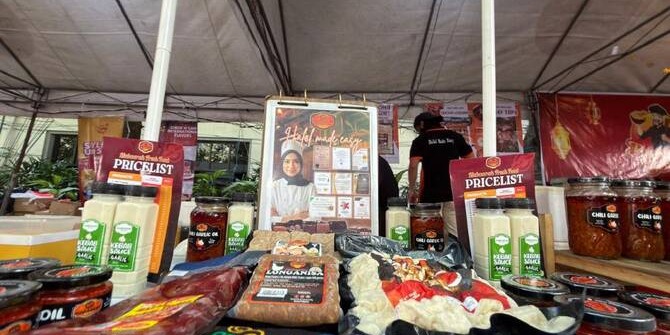
The Manila Halal Festival in March 2026 was a litmus test, illustrating how the policy is beginning to translate into ground-level commercial activity. Around 100 vendors, most specializing in food, snacks, sweets, and supplements, gathered in the capital for a three-day event co-organized by the city government, the Department of Tourism, and the DTI. The exhibitor list included producers of halal pastillas, the Philippines' first certified halal ice cream, beauty products, and food supplies, alongside certification bodies, government agencies, and international pavilions from Indonesia and Canada.

The festival made visible how halal certification is already functioning as a market entry credential for small Filipino producers. Vendors at the event reported gaining new customer segments in the Gulf specifically because of certification, families buying to bring products to Qatar or Saudi Arabia, and export orders to the UAE that began with a single overseas inquiry. The pattern was consistent across food categories: certification opens a door that was previously closed, and Gulf demand is pulling Filipino products through it.

These were small businesses, not export-ready multinationals. But that was precisely the point the 2024–2028 plan is built around: if certification infrastructure is accessible and internationally recognized, SMEs can compete in Gulf markets without the scale that currently makes it difficult. 

"The Philippine halal industry is now aggressively developing its place in a trillion-dollar global industry — building the full halal ecosystem from farm to plate," said Ismail Abaya, Founder and President of 1Halal Global Inc. and Executive Vice President of MASLAHA Halal Certification Board Inc.

The same sentiment was later echoed by Grace Aguilar, Founder and President of Halal Expo Philippines, in an interview with Salaam Gateway. "The Philippines is emerging as one of Southeast Asia's most promising halal markets, driven by strong government support, growing consumer awareness, and increasing interest from both local and international investors. With its strategic location, young population, and commitment to becoming a global halal hub, the country offers tremendous opportunities across food, cosmetics, pharmaceuticals, tourism, and Islamic finance. Halal Expo Philippines was created to serve as the platform that connects businesses, fosters partnerships, and accelerates the growth of the halal ecosystem in the Philippines and beyond, " she said. 

The sectoral depth
Beyond food, the government is simultaneously building out the halal ecosystem in several directions. The Department of Tourism has accredited over 42 Muslim-friendly accommodation establishments, including major hotel groups and resorts. Infrastructure investments include the Marhaba Boracay Cove, an 800-square-meter beach area designed for Muslim travelers, with similar facilities planned for Bohol and Cebu. A QR-code-based Muslim-friendly travel log is in development to help visitors locate halal food, prayer spaces, and services.

The Philippine Economic Zone Authority is creating dedicated halal economic zones, and the central bank, Bangko Sentral ng Pilipinas, is strengthening the Islamic banking sector to provide the financial infrastructure the wider halal industry requires. A collaboration with Turkey on halal-certified poultry production is also underway, to develop a regional hub that leverages Turkish expertise in animal-byproduct-free feed.

On the trade side, the Philippines has been promoting its halal sector at expos in Saudi Arabia, Malaysia, and Canada, and has reported export deals from its international halal promotion campaigns. However, the exact figures have not been corroborated by a single primary source.

Officials are also pursuing mutual recognition arrangements with Muslim-majority countries to ease market access for Philippine products, a critical step given that international recognition of certification bodies is often the deciding factor in whether export opportunities open up.

The challenge is execution at scale
The policy framework is more coherent than anything the Philippines has attempted in this space before. The combination of a four-year plan, a dedicated coordinating office, MSME support infrastructure, tourism investment, and export promotion is a genuine strategy rather than a collection of disconnected announcements.

The Philippines still has a relatively small certified product base — 3,000 products is modest against regional competitors — and the certification system needs to expand and gain broader international recognition quickly enough to meet the 2028 targets. The domestic Muslim population provides a domestic market foundation, but the harder task is building export supply chains, securing recognition of standards, and developing production capacity to compete internationally.


Author Profile Image
Muhammad Ali Bandial