Image Courtesy: Shutterstock

Islamic Finance

Top 10 Islamic fintech ecosystems in 2025


Islamic fintech has emerged in recent times as one of the fastest-expanding segments of the financial technology sector. Yet, despite its growth, it still accounts for only about 1.5% of the global fintech market, suggesting enormous expansion potential in the years ahead. As regulators refine frameworks and venture capital flows into the sector, the countries that combine strong Islamic finance foundations with digital innovation are likely to shape the next generation of ethical finance.

According to the Global Islamic Fintech Report 2025/26, the sector reached $198 billion in transaction volume and assets under management in 2024/25, and is projected to grow to $341 billion by 2029, representing an 11.5% compound annual growth rate (CAGR).
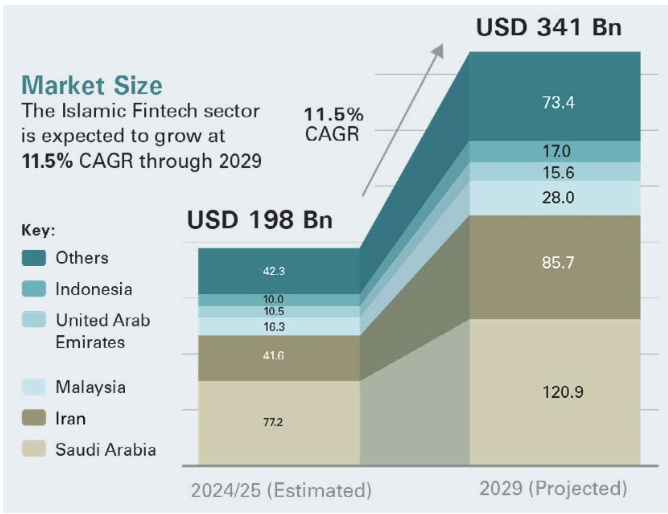
At the same time, the global Islamic fintech ecosystem has expanded to 484 companies worldwide, spanning digital payments, alternative finance, wealth management, crowdfunding, and tokenised assets.

To understand which countries are leading this transformation, the report compiled the Global Islamic Fintech (GIFT) Index, a benchmarking framework covering 64 countries and measuring ecosystem strength across regulation, talent, infrastructure, capital, and market depth.

Below are the 10 strongest Islamic fintech ecosystems in the world today, ranked by their GIFT Index scores.

1. Saudi Arabia
GIFT Index Score: 84.2
The Kingdom hosts 74 Islamic fintech firms, the largest national cluster in the world. Saudi Arabia benefits from one of the largest Islamic finance markets in the world and strong government backing through Vision 2030. Digital banking licenses, open banking regulations, and fintech sandboxes have accelerated growth across payments, lending, and digital asset platforms.

2. Malaysia
GIFT Index Score: 79.1
Malaysia’s long-standing leadership in Islamic banking and sukuk markets provides a natural foundation for fintech innovation. Recent initiatives such as asset tokenisation frameworks and digital banking licenses continue to strengthen its ecosystem.

3. United Arab Emirates
GIFT Index Score: 68.0
The UAE ranks third, with 55 Islamic fintech companies, and is active in payments, digital assets, and investment platforms. Dubai and Abu Dhabi have established fintech sandboxes, regulatory innovation hubs, and tokenisation initiatives, positioning the UAE as one of the most active regulatory environments for Islamic fintech experimentation.

4. Indonesia
GIFT Index Score: 63.0
Indonesia has 58 Islamic fintech companies, reflecting the scale of its domestic market and its large Muslim population. Indonesia’s fintech ecosystem is particularly active in peer-to-peer lending, digital payments, and crowdfunding platforms designed for underserved consumers and SMEs.

5. Bahrain
GIFT Index Score: 49.2
Bahrain rounds out the top five with a GIFT Index score of 49.2. Although its domestic market is smaller, Bahrain has long been an early mover in Islamic finance regulation. The country’s fintech regulatory sandbox and digital banking frameworks have helped it remain influential despite its size.

6. United Kingdom
GIFT Index Score: 46.5
The United Kingdom ranks sixth globally, the highest-ranking non-OIC jurisdiction. The country is home to 52 Islamic fintech firms, reflecting London’s position as a global financial hub. Islamic fintech activity in the UK focuses heavily on digital investment platforms, crowdfunding, and ethical finance solutions, supported by the country’s advanced fintech infrastructure.

7. Qatar
GIFT Index Score: 46.2
Qatar hosts 22 Islamic fintech companies, supported by initiatives such as the Qatar Financial Centre fintech ecosystem and digital asset labs. It’s strategy focuses on regulatory clarity and financial infrastructure to attract startups and international partnerships.

8. Pakistan
GIFT Index Score: 44.2
Pakistan enters the Top 10 for the first time and hosts 19 Islamic fintech companies, reflecting rapid growth in mobile payments and digital banking. Pakistan’s expanding Islamic banking sector and large unbanked population have created fertile ground for fintech innovation.

9. Kuwait
GIFT Index Score: 43.0
Kuwait’s strong Islamic banking sector provides the foundation for fintech innovation, particularly in digital payments, investment platforms, and SME financing solutions.

10. Singapore
GIFT Index Score: 40.8
Although not traditionally an Islamic finance hub, Singapore rounds out the top 10. The country hosts 14 Islamic fintech firms, benefiting from its global fintech ecosystem and strong regulatory clarity. Its role is increasingly that of an international bridge connecting Islamic fintech startups with global capital markets.

Methodology 
This ranking evaluates 64 countries using 19 indicators grouped into five core categories:
• Talent
• Regulation
• Infrastructure
• Islamic Fintech Market & Ecosystem
• Capital

Each indicator is first normalised using a min-max methodology, allowing different data types to be compared on the same scale. Category scores are then calculated and weighted to produce a final composite score for each country. The Islamic Fintech Market & Ecosystem category receives the highest weighting, reflecting the importance of real market activity, such as the number of fintech firms and Islamic financial institutions.

Limitations
While the GIFT Index offers the most comprehensive benchmarking framework available, several constraints remain:

  • Data availability: Islamic fintech activity is not always reported consistently across countries.
  • Proxy-based market estimates: Market size estimates sometimes rely on Islamic banking market share as a proxy for fintech activity.
  • Rapid regulatory change: Digital asset regulations and fintech policies evolve quickly, meaning ecosystem strength can shift rapidly.

Author Profile Image
Muhammad Ali Bandial