What does the future hold for the Abraham Accords?
The year 2020 was a watershed for geopolitics as the world watched the UAE and Bahrain normalize relationships with Israel under the US-brokered Abraham Accords. Announcements on Kosovo, Sudan and Morocco, signaled the beginning of broader Israeli integration into the Arab world.
The world and the Middle East, in particular, has gone through the wringer since, plagued with disrupted supply chains, the Gaza conflict, and centennial high trade tariffs. Furthermore, rising nationalism, deep ideological divides and power shifts have left the world reeling.
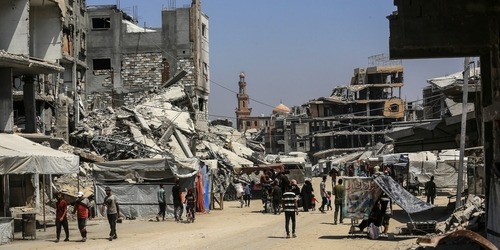
Hence, what was billed as the beginning of transcontinental trade corridors, mending of schisms and greater financial and economic integration has instead been marked by a hardening of positions, fueled by Israel’s war and conduct in Gaza and the indiscriminate attack on several Middle Eastern countries.
Fruits of labour
The Abraham Accords were inked with a new beat of hope and integration with the establishment of several forums and pacts. The UAE-Israel comprehensive economic partnership agreement - the largest between Israel and any Arab country - was arguably the most prominent, seeking to boost bilateral trade to over $10 billion over five years.
“The past five years have demonstrated the tangible benefits of peace. Trade between Israel and the UAE reached over $3.2 billion in goods last year, not including government-to-government transactions or software and services. Investments have surpassed $5 billion, and more than two million Israelis have travelled to the UAE since normalization,” said Amir Hayek, the first Israeli ambassador to the UAE, in an article published in the Atlantic Council’s September issue brief.
“These are not abstract statistics; they represent millions of human interactions and billions of dollars driving growth on both sides,” added Hayek.
The Negev Forum was another initiative, convening Bahrain, Egypt, Morocco, the UAE, the US, and Israel, on matters of regional security and economic cooperation. The UAE, US, India and Israel created the I2U2 Group in 2022, focusing on joint investments and new initiatives followed by the development of the India-Middle East-Europe Economic Corridor (IMEC) a year later.
Accumulated trade between Israel and the Abraham Accord countries, including the UAE, Bahrain, Morocco, Sudan, Egypt, Jordan and Kosovo, exceeded $4 billion in 2023, up 16% on 2022, the Abraham Accords Peace Institute (AAPI) said in its 2023 Annual Report.
…..remain shrouded in doubt
However, the Gaza war has put most of those initiatives under a shadow of doubt.
“The Abraham Accords have survived, but they have changed [in] nature. So, the Abraham Accords are no longer a peace project. They have become a security and resilience framework,” said Ilan D. Scialom, director of strategy, Zalis & European Observatory of the Abraham Accords, during a webinar hosted by the New Lines Institute for Strategy and Policy.
“You can’t stabilize regional economies while Gaza keeps burning every two years. Peace without Palestine narrative is bankrupt” he added. “We are entering what I call Abraham Accords 2.0 – not a sequel but a recalibration.”
Is the future in the balance?
New countries keen or even agreeing to join the Abraham Accords is on the cards. Kazakhstan has agreed in principle to join last month, becoming the first country in US President Donald Trump’s second term to do so.
Sir Liam Fox, Chairman, Abraham Accords Prosperity Group, said that there is a change in the mindset of how people now see the Gulf region as one of opportunity. “This is the moment, this is the time for investments in this region,” he said at a summit.
However, experts suggest that the vision of an integrated Middle East is contingent on a peaceful Palestine narrative.
“The impact and aftermath of October 7 have reverberated around the region, making further progress on normalization more complicated. They have also underscored how the domestic and strategic interests of key regional players are still deeply intertwined with the Israeli-Palestinian conflict,” Yael Lempert, former US ambassador to Jordan said at a policy forum held by the Washington Institute.
“The vision of an integrated Middle East will not be fully realizable without a pragmatic vision for resolving this conflict in a way that includes a viable future Palestine.”
Editor